MedCo, developed in the LDS lab of professor Jean-Pierre Hubaux in collaboration with professor Bryan Ford’s DEDIS lab and the Lausanne University Hospital (CHUV), is the first operational system that makes sensitive medical-data available for research in a simple, privacy-conscious and secure way. It enables hundreds of clinical sites to collectively protect their data and to securely share them with investigators, without single points of failure. MedCo applies advanced privacy-enhancing techniques, such as: Multi-party homomorphic encryption, Secure distributed protocols and Differential privacy.
More than one million families are separated due to conflicts. The ICRC and the EPFL through C4DT partnership have set themselves a challenge to analyse publicly available data through analytics techniques to identify missing persons that would arguably not have been identified using current, conventional methods. The goal of this project is to facilitate the search for missing individuals by building scalable, accurate systems tailored for that purpose.
2018 was a crazy year for privacy. The General Data Protection Regulation came into force in May, and new revelations on the personal data ecosystem were making headlines on a weekly basis. I will give the behind the scenes for a lot of these events, question why they didn’t happen earlier, and offer some thoughts (…)
Being able to understand fundamental data protection challenges, interpret the technical implications of cyber, data protection and privacy law, advise third parties, and communicate properly with technical experts who develop and maintain digital systems are crucial for lawyers. With these goals mind this course is developed by C4DT in close cooperation with the International Committee of the Red Cross (ICRC) and builds on the first course held for its lawyers at the end of February 2018.
Power systems (smart grids)
Data mining and machine learning
Health and genomic information management
[et_pb_section fb_built=”1″ _builder_version=”3.18.2″ background_color=”rgba(255,255,255,0.03)” background_size=”contain” background_position=”top_left” custom_padding=”0|0px|20px|0px|false|false” top_divider_color=”#0091aa” top_divider_height=”44px” top_divider_flip=”horizontal” bottom_divider_height=”33px” bottom_divider_flip=”horizontal|vertical” custom_margin=”65px||”][et_pb_row custom_padding=”0|144px|0|23px|false|false” custom_padding_tablet=”|0px||7px|false|false” custom_padding_last_edited=”on|phone” _builder_version=”3.18.2″ background_size=”contain” background_position=”bottom_right”][et_pb_column type=”4_4″ _builder_version=”3.17.6″ parallax=”off” parallax_method=”on”][et_pb_text _builder_version=”3.18.2″ _dynamic_attributes=”content” text_font=”|700|||||||” background_layout=”dark” custom_margin=”||0px”]{“dynamic”:true,”content”:”post_title”,”settings”:{“before”:” “,”after”:” “}}[/et_pb_text][et_pb_text _builder_version=”3.18.2″ _dynamic_attributes=”content” text_font=”Verdana||||||||” text_font_size=”22px” text_font_size_tablet=”18px” text_font_size_phone=”16px” text_font_size_last_edited=”on|phone” text_line_height=”1.4em” background_layout=”dark”]{“dynamic”:true,”content”:”post_excerpt”,”settings”:{“before”:””,”after”:””,”words”:””,”read_more_label”:””}}[/et_pb_text][/et_pb_column][/et_pb_row][/et_pb_section][et_pb_section fb_built=”1″ _builder_version=”3.17.6″ top_divider_flip=”vertical” bottom_divider_color=”#111111″ bottom_divider_height=”44px” custom_padding=”3px|0px|54px|0px|false|false”][et_pb_row custom_padding=”|||25px” _builder_version=”3.17.6″ custom_margin_last_edited=”on|desktop”][et_pb_column type=”4_4″ _builder_version=”3.0.47″ parallax=”off” parallax_method=”on”][et_pb_code _builder_version=”3.18.2″][loop type=article paged=5 (…)
A growing number of wearable devices are becoming available. By their ability to measure physical activity and physiological characteristics such as heart rate, blood pressure, sleep patterns, etc., they constitute a cornerstone for the quantified self and personalized health. Yet, unavoidably, they bring a number of challenges in terms of security and privacy. 10:15-13:00 – (…)

A growing number of wearable devices are becoming available. By their ability to measure physical activity and physiological characteristics such as heart rate, blood pressure, sleep patterns, etc., they constitute a cornerstone for the quantified self and personalized health. Yet, unavoidably, they bring a number of challenges in terms of security and privacy.
This workshop will be held on Thursday, 6 December from 10:15-13:00, in room BC 410 at the EPFL.

The International Red Cross (ICRC) is confronted to unique information-security challenges when providing aid to disaster victims. A group of C4DT-affiliated researchers has been closely working with ICRC to better understand specific computer security challenges.
For that work, Steven Leblond and his colleagues led by professors Ford and Hubaux were awarded the Distinguished Best Paper Award at the 39th IEEE Symposium on Security and Privacy in San Francisco.

A group of lawyers and policy workers from the International Red Cross (ICRC) and other organizations concluded a computing and digital trust awareness-raising training at EPFL.The week-long course in collaboration with C4DT is intended to equip them with the tools to evaluate the impact of information systems on their humanitarian activities. The course starts from computing basics and touches cloud computing, information security and privacy preservation.
A group of lawyers and policy workers from the International Red Cross (ICRC) and other organizations concluded a computing and digital trust awareness-raising training at EPFL.The week-long course in collaboration with C4DT is intended to equip them with the tools to evaluate the impact of information systems on their humanitarian activities. The course starts from computing basics and touches cloud computing, information security and privacy preservation.
Plus d’une vingtaine de signalements reçus en quelques mois par l’association française e-Enfance concernant des femmes filmées à leur insu par les lunettes connectées Ray-Ban Meta. Ce chiffre, assez bas en apparence, doit être remis dans son contexte : la plupart des victimes ne se rendent pas compte qu’elles ont été enregistrées et une autre (…)
Mauvaise nouvelle pour la protection des utilisateurs et utilisatrices des grandes plateformes en ligne que le retrait de l’ordre du jour du Conseil fédéral de la loi sur la régulation des plateformes numériques (LPCom). Face à un clivage entre les différents bords politiques, l’institution a en effet décidé de reporter l’analyse de ce texte à (…)
Melanie Mitchell’s take on the Hugging Face attack and similar incidents in the last few weeks is what the public debate on AI currently desperately needs: a measured and thoughtful analysis of what actually happened, what to learn from it, and, crucially, how to talk about it.
Cela me réjouit que la Confédération suisse ait décidé de poursuivre le programme BOSS pour passer de la théorie à la pratique. BOSS était un projet visant à évaluer la possibilité d’utiliser une alternative à Microsoft Office. La Confédération souhaite désormais tester ce système en conditions réelles et disposer de 3 000 postes de travail (…)
South Korea’s decision to treat AI as public infrastructure, funded by the state, built on domestic operators, and explicitly designed to prevent both an AI literacy divide and dependency on foreign platforms, is the most serious government AI commitment to date. The contrast with Malta says everything: one country bankrolled ChatGPT Plus and called it (…)
The author’s conclusion that with agentic AI following security fundamentals has never been more important is certainly worth repeating. But their experiment shows that the problem goes deeper than that. So much of our technology stack is not built to be resilient to attackers that can at literally superhuman speed mix and match exploits – (…)
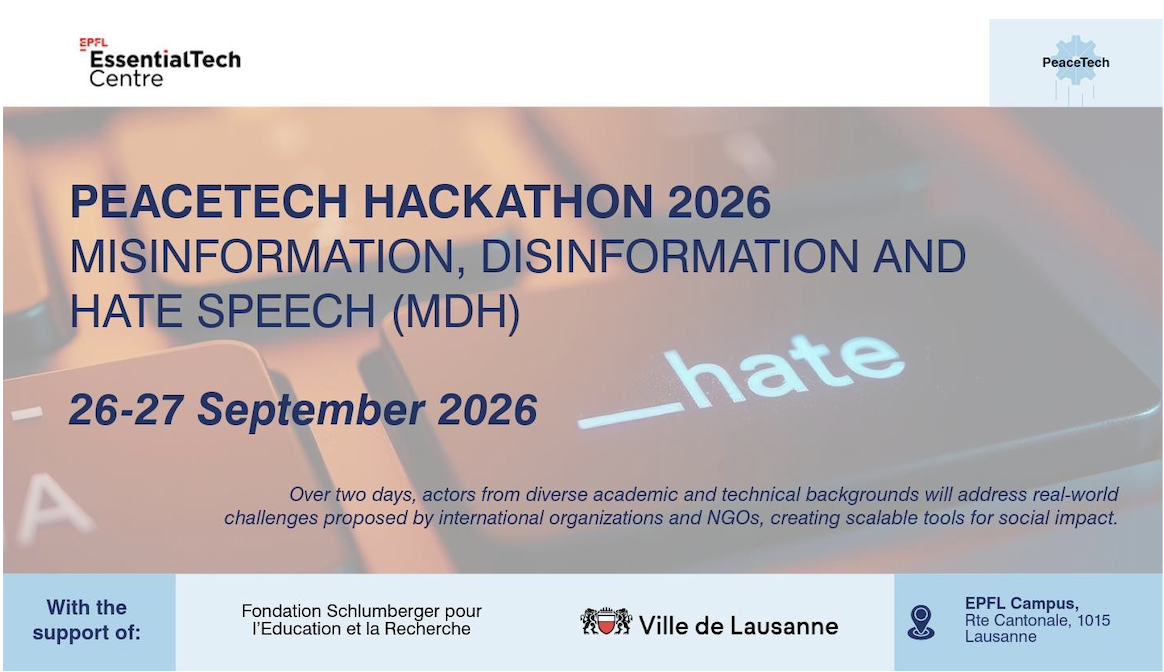
This year’s edition will focus on the critical challenges of Misinformation, Disinformation, and Hate speech (MDH), with a particular emphasis on gender-based violence (GBV).

The next internship session for EPFL Master’s students is now open! We are seeking new internship opportunities within your company.
Start submitting now and preferably by October 2026 (by mid-September for students in Computer Science and in Communication Systems).
A computer should never make decisions significantly affecting humans. This is the foundation principle of many data protection laws across the globe. However, its implementation has sometimes proven flawed; consider how banks frequently rely on algorithms to determine credit rates. A recent decision by the Dutch Data Protection Authority, acting as the leading supervisory authority (…)