This article fascinates me because it exposes Proton Mail’s privacy limits under Swiss law. While Swiss law shields direct foreign access, Mutual Legal Assistance Treaties (MLAT) enables indirect cooperation—Swiss firms must disclose available metadata like payment data. This reveals limitations in what Switzerland’s privacy protections can shield users from in cross-border investigations.

Human Rights Week is a 3-day congress exploring the dual impact of digital tools: empowering activism while enabling new forms of control. Participants examine how technology is transforming human rights and envision a more just digital future. Dr Olivier Crochat, C4DT’s executive director, will join a panel on digital platforms’ role in contemporary conflicts.
We are incredibly proud to announce the publication of C4DT’s 2025 Annual Report. As geopolitical tensions and the AI race intensify concerns about digital sovereignty, our work has never been more vital, thanks to our partners, researchers, and dedicated team.
I like the idea behind this tool because it tackles a serious online societal problem. I’m curious if and how it will pass the test of time. The key challenge will be to link subjective criteria to objective metrics – a problem we’ve seen with privacy, which still lacks objective benchmarks despite substantial research. But (…)
This article caught my attention because it exposes the threat of de-anonymization that AI agents pose and its consequences for online privacy. The author writes that ‘the implications stretch far beyond embarrassing social media reveals’ and points out that whistleblowers who reveal corporate misconduct and government corruption, journalists who shield their informants, and political dissidents (…)
This analysis of India’s technological dependence reveals patterns that are also applicable to Europe. Attracting foreign tech companies to invest locally ultimately results in profits being exported abroad, exemplifying a kind of digital colonialism. In my opinion, the solution lies in a demand-side strategy that favors local and open-source products over monopolies such as Microsoft (…)
The C4DT Factory, together with Dr. Anna Sotnikova from Prof. Antoine Bosselut’s Natural Language Processing lab, is happy to invite you to our upcoming hands-on workshop on LLM evaluation and benchmarking. Our hands-on workshop is designed to demystify LLM benchmarking and provide you with a clear roadmap for your next LLM project. You will learn: (…)
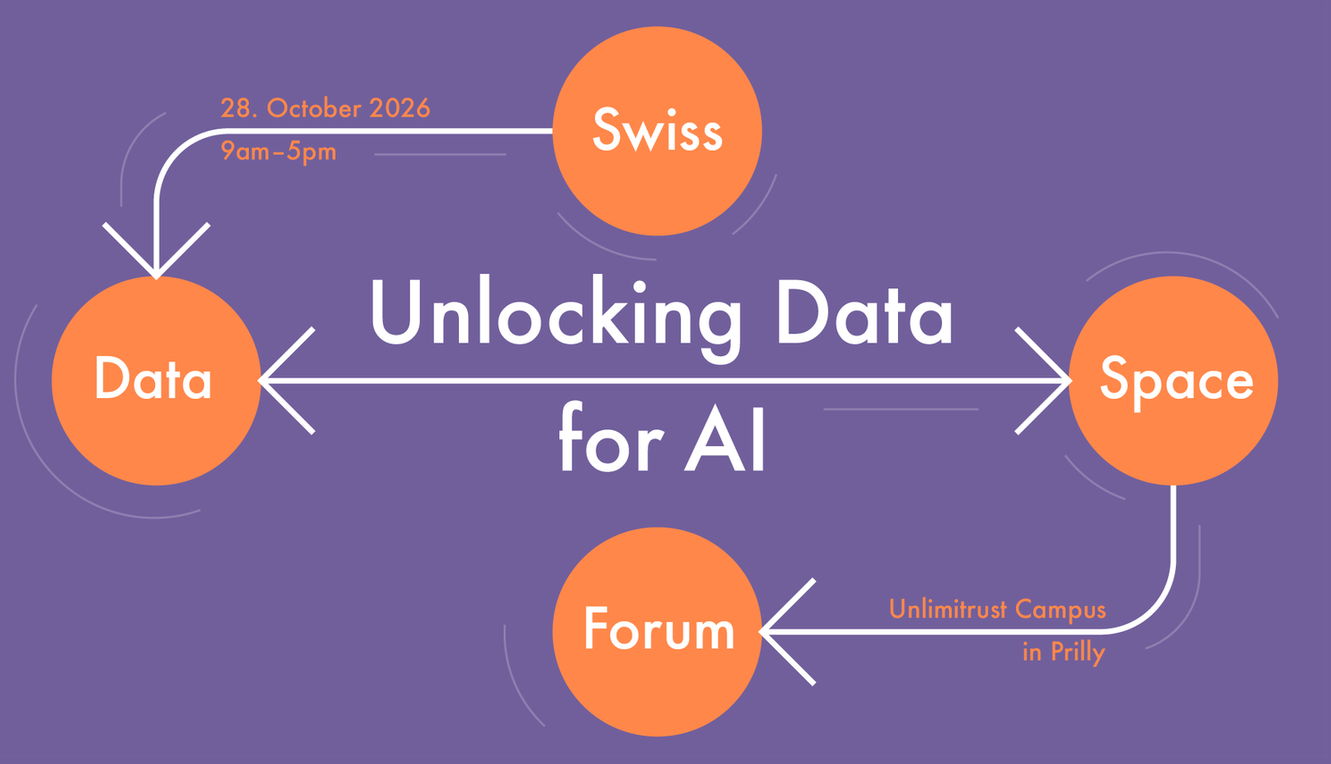
Artificial intelligence thrives on data — yet much of it remains locked in siloed structures. The Swiss Data Space Forum 2026, organised by digitalswitzerland, brings together policymakers, researchers, industry leaders and innovators on 28 October at the unlimitrust campus in Prilly to explore how to unlock data for AI in a way that is secure, trustworthy and values-driven. C4DT is organising a dedicated track at this year’s edition — more details to be announced soon.
Organized by intergovernmental and non-governmental organizations, particularly standard development and open source organizations, this event will bring together 2,000 sector leaders by invitation only through co-organizers. Over the course of three days, participants will explore the global pulse of cross-sector innovation, with the primary objective of bridging gaps and solving interoperability challenges.

The AI for Good Global Summit brings together experts, policymakers, and innovators to explore how artificial intelligence can help address global challenges and achieve the United Nations Sustainable Development Goals. It has become a major global platform for promoting responsible and beneficial use of AI.
Sogar für eine Firma, die die Privatsphäre als Aushängeschild verwendet, ist es nicht immer einfach, ihre Benutzer zu beschützen: Obwohl die E-Mails selbst verschlüsselt sind, gibt es viele Metadaten. In diesem Fall war es die Zahlung mit einer VISA-Karte, die den Benutzer einer E-Mail-Adresse verriet. Ich finde es interessant, dass Proton laut einem eigenen Bericht (…)
As someone who is a passionate reader since first opening a book, I thoroughly enjoyed this article by an aspiring English teacher reflecting on how to pass on this passion to the next generation in the age of AI. I particularly liked its message on how technology in the classroom is not an end in (…)
This article illustrates the brutal economics of modern conflict and the fragility of digital infrastructures. Relatively inexpensive drones can render billion-dollar data centers ineffective, calling into question their placement in supposedly “stable” regions. For me, a question remains: What explains the apparent lack of cyberattacks by Iran? Have the U.S. and Israel blocked such attempts (…)
Unsurprisingly, the cyberspace reflects the geopolitical conflicts of the real world. We see western democracies criticising authoritarian regimes for cutting off their populations from the Internet for fear of external interference and fuelling demonstrations. Similarly, within the western democracies, the current US administration criticises the EU for its regulations and censorship of hate speeches, fake (…)
Insomni’hack is a five-day cybersecurity event featuring intensive workshops (Mon-Wed) and expert talks (Thu-Fri), culminating in an overnight Capture the Flag (CTF) competition. The CTF challenges 700 participants in teams of up to eight to solve security puzzles and exploit vulnerabilities. Beyond technical training, the event serves as a key networking hub for cybersecurity professionals and enthusiasts, fostering a community-oriented environment that welcomes participants of all skill levels.
En tant que supporteur des logiciels libres et de la souveraineté qui les accompagne, voici un sujet qui m’inquiète : Google veut fermer sa plate-forme Android à toute application qui n’est pas signée par un développeur agréé par Google. Le sujet fait débat surtout en Europe, où Apple a dû ouvrir ses iPhones aux applications (…)
Even 3 years into the current AI hype, it is still difficult to differentiate between its true capabilities and salestalk. Hopefully military leaders have a more clear-eyed view of the technology, as it is clearly not ready to be deployed in high-stakes decision-making processes.
This article is quite unnerving: a twenty‑minute hack shows how data‑poisoning can make LLMs tell tall tales, turning sci‑fi fears into real business risk. It’s a wake‑up call to demand provenance, adversarial robustness assessment and scepticism—because trusting chatbots without checking is like relying on a smooth-talking oracle with a hidden agenda. Critical thinking remains your (…)
As quantum technologies move from research to engineering reality, organizations must navigate both technical and governance challenges to keep digital infrastructures trustworthy. This roundtable, organized by C4DT, explores how Swiss actors—public and private—are preparing for post‑quantum security, drawing on armasuisse’s strategic threat assessment, Swisscom’s journey toward quantum-safe operations, and Kudelski’s expertise in robust crypto implementations and root-of-trust solutions.
This case is striking in that, while we usually focus on the risks of data theft and profiling from Big Tech, the core threat here is addiction and its devastating long-term impact on the mental health of young people, such as depression, anxiety and body dysmorphia. Internal documents prove that Meta was aware of the (…)
Since ChatGPT crashed onto the scene in late 2022, attacks involving LLMs have kept pace with the breakneck speed at which they are being integrated into every aspect of our digital lives. This paper is the first that I’m aware of that takes a step back and not only catalogues the attacks by type, but (…)
Eine Studie über Open-Source Passwort-Managern, die die Passwörter in der Cloud speichern. Da die Programme öffentlich einsehbar sind, hat ein Student von der ETHZ nach Schwachstellen gesucht, und einige gefunden. Alle Fehler waren nur durch einen bösartigen Betreiber ausnutzbar, hatten aber zur Folge, dass Passwörter veränderbar oder sogar einsehbar waren. Die drei Passwort-Manager haben die (…)
Les attaques de phishing, de plus en plus ciblées et difficiles à détecter, touchent PME, institutions et particuliers ; pour y répondre la HEIG‑VD a lancé le projet « Combattre le Phishing – quelles innovations apporter » en partenariat avec le Center for Digital Trust (C4DT) de l’EPFL, l’UNIL, la Police cantonale vaudoise, la DGNSI, (…)
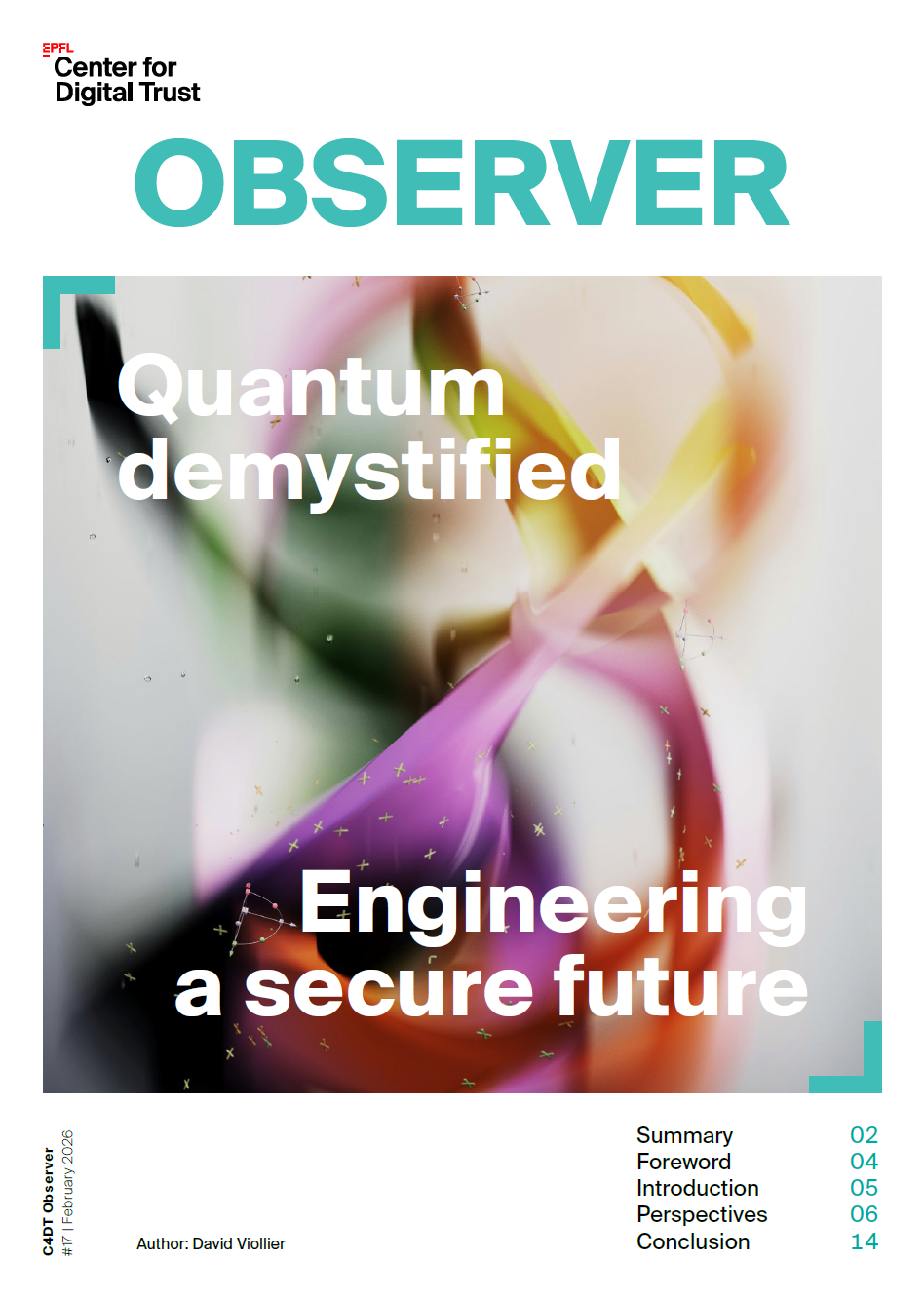
This publication summarizes the key perspectives shared by participants at the roundtable “Quantum Demystified: Engineering a Secure Future”, organized by C4DT in collaboration with SICPA on September 18, 2025.