For a bit more than three years, DEDIS has been working on a blockchain based on the byzcoin paper. The groundwork has been laid to add client interactions, first as a number of command line interfaces, then a first web-interface, a second interface added by C4DT as a demonstrator, and now, finally, a mobile app (…)
When working on the command line, it is common to build complex commands that connect sub-tasks through the pipe. In those situations, it can be useful to have an idea of the data transferred between two connected processes. For example, what is the throughput? What about the volume of data transferred? Enter pv. You can (…)
Most projects need organization. There exists a bunch out there, from the post-its laying on the desk to a huge kanban spanning the whole chain of supply. With code¸I find using the same layout as the project is pretty practical: when digging deeper inside it, you get more relevant information, tagging these closer to the (…)
Protecting your SME from cyberattacks is often complicated: costs of IT security audits, absent or overly complex standards, lack of internal skills have discouraged more than one company from confronting these risks.
Born from a participative approach, the Label cyber-safe.ch helps SMEs and other small organizations to manage their cyber risks pragmatically. Since December 9, a free tool allows to easily assess the exposure of an SME on the website www.cyber-safe.ch.
Please click below to access the official press release in French.
The Center for Digital Trust is always searching for novel ways to decentralize control of users accounts so we don’t have to rely on a centralized structure that can be abused by administrators. Currently we have three kinds of services that we offer to our partners: A matrix.c4dt.org installation for internal discussions Our demo.c4dt.org demonstrators (…)
The rising importance of data has thrown up new challenges ranging from competition policy to privacy to the geostrategic implications of 5G. The goal of this conference, organized in collaboration with The Graduate Institute in Geneva (IHEID), is to boost understanding of what data is and help to develop mindsets and attitudes that are based on technical and economic realities rather than the myths and shallow discussions that so often appear in popular media. For more information, please click below…
March 19th, 2020, 08:00-18:00 @ The Graduate Institute, Geneva, Maison de la Paix, Auditorium A1.
The cryptocurrency Bitcoin is limited by its astronomical electricity consumption and outsized carbon footprint. A nearly zero-energy alternative sounds too good to be true, but as C4DT-affiliated Professor Rachid Guerraoui explains, it all comes down to our understanding of what makes transactions secure. DCL’s new system, dubbed Byzantine Reliable Broadcast, can achieve safe cryptocurrency transactions on a large scale with an energetic cost of virtually zero. Read EPFL’s press release by clicking on the following link.
On Thursday October 3rd the C4DT will kick off the IoT Security workgroup with its launch workshop held at the EPFL. Nine C4DT partner companies will develop an understanding of each other’s challenges and needs in IoT Security and share insights on such projects. Prof. David Atienza and Dr. Amir Aminifar from the C4DT-affiliated Embedded Systems Laboratory (ESL) provide insights into their state-of-the-art research.
In this talk, Dan Bogdanov will start by introducing secure computing technologies and their potential in enterprise and government use. He will then look at a focus group study of the barriers of adopting such technologies based on interviews in many industries.
September 4, 2019 @ 14:15 in BC 410
This course is intended for professionals—decision makers, advisers, lawyers—from organizations which, like ICRC, see information and communication technologies (ICT) as an opportunity to better engage with beneficiaries and clients.
The next course will be held on 25-29 November 2019 @ Humanitarium, ICRC headquarters in Geneva.
The Cyber-Defense Campus holds its inaugural Conference on Artificial Intelligence in Defence and Security on the 5-6 September 2019 at the SwissTech Center in Lausanne. Speakers will be drawn internationally from all defence and security areas of industry, academia, military and government. The discussed AI topics will range from new scientific findings to the benefits and usability of AI techniques. For more information please click here…
Wide-area data stores enhance fault tolerance and response times, and they enhance scalability. Yet even in the absence of failures, these wide-area deployments can degrade the interaction latency between nearby clients. Cristina Basescu presents Crux, the first general framework that addresses these issues by building locality-preserving data stores.
Wednesday, June 19th, 2019 @16:15 room BC 410
by Prof. Raluca Popa, UC Berkeley
Many organizations wish to collaboratively train machine learning models on their combined datasets for a common benefit (e.g., better medical research, or fraud detection). However, they often cannot share their plaintext datasets due to privacy concerns and/or business competition. In this talk, Helen will be presented, a system that allows multiple parties to train a linear model without revealing their data, a setting we call coopetitive learning.
On the 4th of June, the Council of States debated the Swiss law on e-ID (Federal Act on Electronic Identification Services, LSIE). C4DT’s academic director Prof. Jean-Pierre Hubaux wrote an article on the topic for the Swiss French-language daily newspaper ‘Le Temps’, in which he favors state control of all e-ID processes with private sector engagement.
Read the article by clicking on the following link.
The School of Computer and Communication Sciences (IC) invites you all to attend this year’s IC Research Day, held at EPFL’s SwissTech Convention Center on the 6th of June, where world-leading experts will present and discuss their work toward building trust in a digital world. EPFL researchers will showcase ongoing research projects and engage with the audience.
Registration is free. Discover the full program here…
While showing great promise, smart contracts are difficult to program correctly, as they need a deep understanding of cryptography and distributed algorithms, and offer limited functionality, as they have to be deterministic and cannot operate on secret data. In this talk, Ceyhun Alp presents Protean, a general-purpose decentralized computing platform that addresses these limitations.
This workshop will be held on the 20th of May 2019 the the EPFL and aims to inform researchers and industrial partners, active in the field of cybersecurity / digital trust, about current opportunities to fund multilateral projects (collaborative projects involving multiple research and industry partners) using H2020 as well as other Swiss and EU sources of financing.
Please note that this is a closed C4DT community event.
The UZH Blockchain Center is organising a Swiss-wide Symposium on Blockchain Research to take place on the 14.05.2019 in Zürich. In such an event, two principles are fundamental: (1) Academic, interdisciplinary programme; (2) Federal coverage. It is just fair (and interesting) to learn what Universities of this country are doing in the area now. This allows to form a sense of community, find possible synergies and plainly learn. Please register for this event.
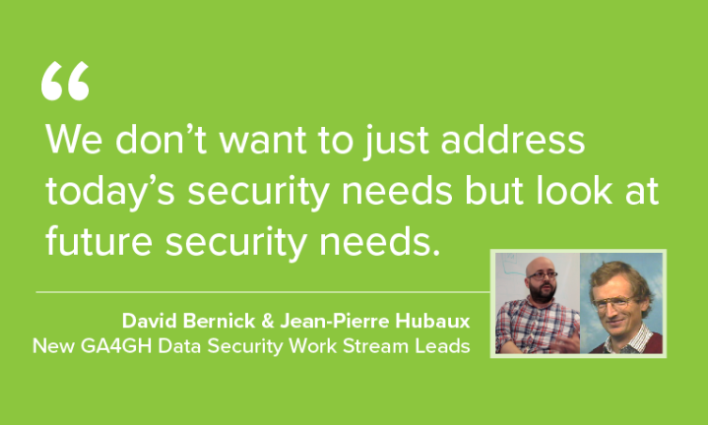
C4DT-affiliated Jean-Pierre Hubaux, a Full Professor at École polytechnique fédérale de Lausanne (EPFL) and lead of the Data Protection in Personalized Health (DPPH) initiative in Switzerland, and David Bernick, Chief Information Security Officer at the Broad Institute of MIT and Harvard, take on leadership of the Global Alliance for Genomics and Health (GA4GH) Data Security Work Stream.
In this talk, Nicolas Badoux presents MinFuzz, his approach to discover and remove prunable code blocks to improve fuzzing effectiveness. First, he will discuss which computations are “skippable”. His system targets particularly decompression, decryption, and checksum computations […]
Researchers in the HexHive and Parallel Systems Architecture (PARSA) laboratories of EPFL’s School of Computer and Communication Sciences, in collaboration with IBM researchers, have identified a widespread computer security vulnerability affecting laptop, desktop and server hardware.
The 2nd SDSC-Connect workshop named “Paving the way for Digital Manufacturing” will take place at the Kursaal, Bern. It will address the sometimes unforeseen challenges in a data-driven world and leading industry experts will share their views on the 4th industrial revolution we are experiencing.
The CV Summit is a unique event held in the heart of the Crypto Valley – in Zug hosting almost 1000 attendees. Switzerland and Lichtenstein have established themselves as the Crypto Valley, through the openness of the Swiss government it has become home of some of the most renowned crypto and blockchain companies such as: Aragon, Ethereum and many more who have established themselves in Zug.
More than one million families are separated due to conflicts. The ICRC and the EPFL through C4DT partnership have set themselves a challenge to analyse publicly available data through analytics techniques to identify missing persons that would arguably not have been identified using current, conventional methods. The goal of this project is to facilitate the search for missing individuals by building scalable, accurate systems tailored for that purpose.