2023-2024 C4DT Digital Trust Policy Fellows Leonila Guglya Leonila holds a Ph.D in International Trade Law (University of Geneva, 2017) and an SJD in International Arbitration (Central European University, 2010). Leonila is a counsel of the International Trade / WTO Law Practice of SwissLegal Rouiller et Associés in Geneva and has worked with several international (…)
This website collects several ressources for technology policy paper writing. This collection is not exhaustive but periodically updated. What is a Policy Paper? Very succinctly and a bit simplified put: A policy paper is a concise summary of what is known about a particular issue or problem and what political actions are recommended to address (…)
Part of the work of the C4DT Factory is the creation of demonstrators (proof of concepts) of technology coming out of the EPFL/IC labs. After two years we archive them and provide you with the means to easily run the demo on your computer instead. That way the demo remains accessible to you and you (…)
The Global Encryption Forum, which will be held at the unlimitrust campus on 19 October in Lausanne. Industry leaders, experts, and professionals (including EPFL Professors Jean-Pierre Hubaux and Serge Vaudenay), are brought together to delve into the intricate web of encryption’s economic implications in our interconnected world.
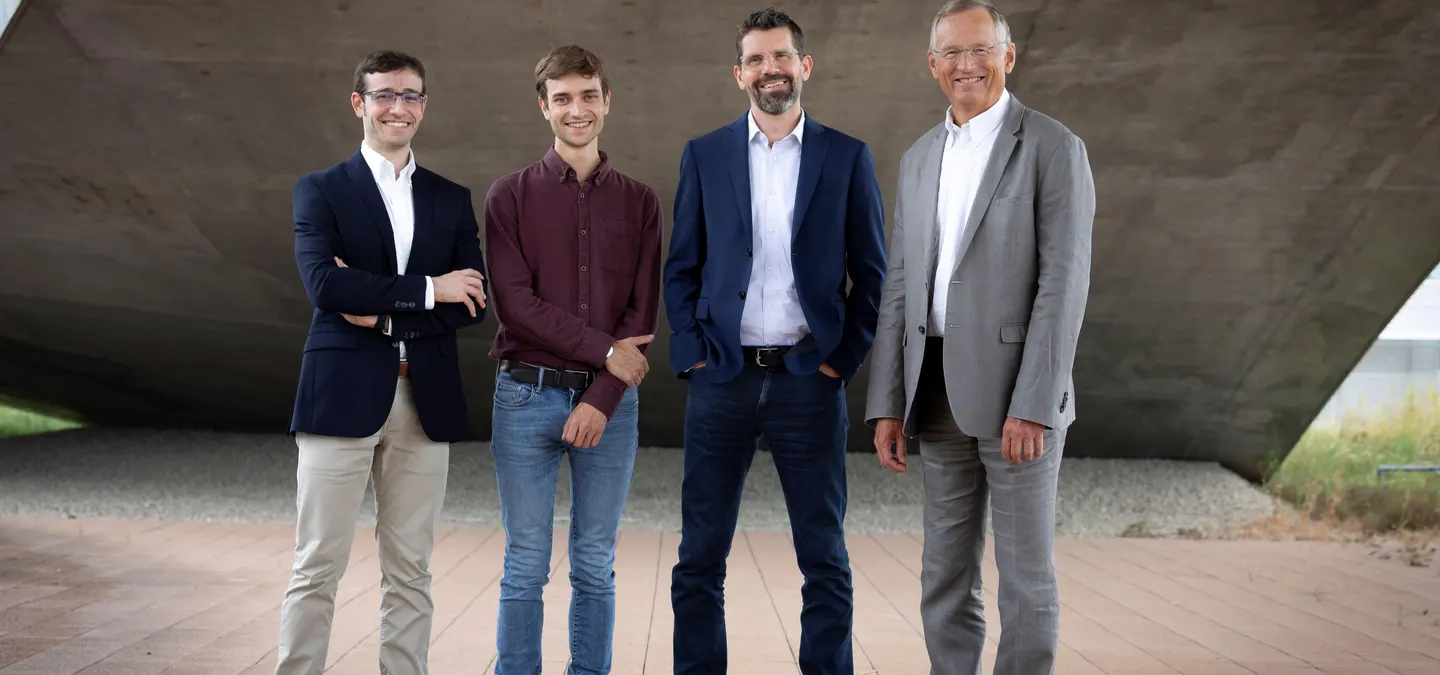
[Langue : Anglais] Tune Insight, a company launched in 2021, is tackling today the challenge of understanding how some organizations get their hands on protected data, using a technique known as “multi-party homomorphic encryption”. The company unlocks the power of sensitive data collaborations and valorization through state-of-the-art privacy and encryption technologies.

Julia Rebstein, a student from the GymInf program, just finished and presented her project “Trace(r)s on the web – Julia Rebstein“. She explains how different types of cookies fonction, and looks at a 1-week sample of browsing sessions from 10 persons. Under the supervision of Linus Gasser and Sandra Siby, Julia put together a simple (…)
Julia Rebstein, a student from the GymInf program, just finished and presented her project “Trace(r)s on the web – Julia Rebstein“. In it, she explains how different types of cookies work, and looks at a 1-week sample of browsing sessions from 10 persons. Under the supervision of Linus Gasser and Sandra Siby, Julia put together (…)
Are the recently adopted (or still negotiated) international rules regulating the development, (crossborder) sales, marketing, and use of software in the best interest of technologists and the tech industry? In this issue brief, C4DT Digital Trust Policy Fellow Leonila Guglya critically examines international digital product regulations that are of key relevance to the ICT community, (…)
On 20 September 2023, the Trust & AI Forum will take place, an event to explore the intersections of artificial intelligence (AI) and digital trust. The Trust & AI Forum aims to provide a broad reflection on the impact of AI in the trust economy, focusing on the challenges and opportunities, as well as the ethical and social implications of recent technological developments.
In this issue brief, C4DT Digital Trust Policy Fellow Leonila Guglya examines international digital product regulations that are of key relevance to the ICT community, such as mandatory disclosure of source code, use of cryptography, cybersecurity standards, and nondiscrimination rules.
By Imad Aad, Technical Project Manager, C4DT *This blog post has been written as part of the Geneva Dialogue on Responsible Behavior in Cyberspace. Everyone can develop software, and the resulting quality can vary considerably. There is no single ‘right way’ to write code and reach a given goal. Numerous technologies exist with increasing (…)

Development in research is very different from development in an industrial context. Many popular DevOps tools can nonetheless be effectively used in research development as well. Docker, an open-source containerization platform, is one such a tool. This blog post shows how Docker can help you develop the software needed for your research, and gives some ideas on how to integrate it in your day-to-day workflow.

Cars are becoming a crucial battleground for cyber attacks, epitomised by the move towards electrical vehicles (EV)
and autonomous driving. To increase the knowledge and expertise held in Switzerland in this area, the CYD Campus
is planning a one-week hackathon in October 2023 for stakeholders, researchers, and students. The CYD Campus
will provide a range of automobile platforms including software, electronic control units (ECUs) and several cars for
extensive testing and training during this week.
![[FR] Le COVID-19 est devenu un compagnon de l’humanité](https://c4dt.epfl.ch/wp-content/uploads/2023/07/Capture-décran-2023-07-11-à-16.22.01.png)
Deux grands programmes de recherche suisses scrutent les aspects autant biomédicaux que sociaux du SARS-CoV-2. Pour leurs représentants, Marcel Salathé, affilié au C4DT, et Samia Hurst-Majno, ces travaux pourraient nous aider à mieux gérer les futures crises sanitaires.
September 13th, 2023, Starling Hotel, St.-Sulpice Overview The concept of digital sovereignty gains increasing traction in political discourses across Europe, including in Switzerland. Digital sovereignty is referred to when speaking about AI development, cloud computing, data and data spaces, hard- and software development, the provision of digital services and platforms, to name but a few (…)
The TUM Blockchain Club is one of the largest student-led blockchain club in Germany, dedicated to enhancing the student blockchain ecosystem and fostering a community of academics, students, and professionals committed to utilizing blockchain for positive purposes. This 2-day event will host 50+ talks, and a number of workshops.
The objective of the project is to perform online monitoring of technologies and technology actors in publicly accessible information sources. The monitoring concerns the early detection of mentions of new technologies, of new actors in the technology space, and the facts related to new relations between technologies and technology actors (subsequently, all these will be called technology mentions). The project will build on earlier results obtained on the retrieval of technology-technology actors using state-of-the-art NLP approaches.
Generative AI and foundation models promise to change the world as personal computers, the web and mobile computing did before them.
To share perspectives from the forefront of this transition, some of the leading academic and industry shapers in this exciting area will be in EPFL for an AMLD special symposium to discuss these advances, their transformative potential, and the future risks they pose to society.
The Swiss Crypto Day is an informal event to promote research in cryptology in Switzerland. It will take place at irregular intervals. After a 3 year long hiatus, the second edition will be taking place at ETH Zürich on Friday 8 September 2023.
In Visual Hash Project EPFL partners with SICPA in order to provide guidance and use the technical expertise of scientists from Multimedia Signal Processing Group for assessing the performance of novel imaging technologies for security, privacy and digital identity.
The Summer Research Institute (SuRI) is an annual event that takes place at the School of Computer and Communication Sciences of the École polytechnique fédérale de Lausanne, Switzerland.
This year the workshop will be bringing together 17 researchers and experts from academia and industry for research talks and informal discussions, including a poster session.
The annual Privacy Enhancing Technologies Symposium (PETS) brings together privacy experts from around the world to discuss recent advances and new perspectives on research in privacy technologies. PETS addresses the design and realization of privacy services for the Internet and other digital systems and communication networks.
The 23rd PETS will be a hybrid event with a physical gathering held in Lausanne, Switzerland and a concurrent virtual event.

This one-day conference examines the technological, political, legal, and economic aspects of secure and trustworthy cloud computing within the context of digital sovereignty, addressing concerns such as data privacy, data localization, security, control and ownership, and legal frameworks. The conference sets out to understand how the Swiss cloud computing space can pro-actively be shaped by fostering collaboration between the public and private sectors, NGOs and academia, and local and international players. With individual talks, panel discussions, and debates, the event seeks to gather knowledge and perspectives from key actors in Switzerland and Europe.

PLSC is a paper workshop conference. It follows a format where a discussant, rather than the author, introduces and leads a discussion on the paper. There are no panels nor talking heads, and everyone is a “participant”.